
 Most companies with a travel compliance problem do not have a policy problem. They have an enforcement problem.
A significant share of business travellers make bookings outside their company’s travel policy — not to be difficult, but for practical reasons: staying closer to a meeting, being in the same hotel as a client, or because the approved option was genuinely less convenient. The policy existed. The employees knew it existed. They chose to ignore it anyway.
This is the travel policy compliance gap, and it costs organisations far more than the occasional out-of-policy hotel booking. Uncontrolled spend, incomplete duty-of-care data, and manual reconciliation that consumes hours of finance and operations time every month are all downstream consequences of the same root cause: travel policy enforcement that happens after the booking, not during it.
This article explains why traditional compliance approaches fail, what good enforcement actually looks like, and how a corporate booking tool solves the problem at the point of booking — before the out-of-policy choice is ever made. For a broader foundation on building a travel policy, see our guide on corporate travel policy for Asia.

What Is Travel Policy Compliance?
Travel policy compliance is the degree to which employees book and expense business travel in accordance with their company’s approved travel policy. A compliant booking is one that uses approved channels, stays within fare and rate caps, follows preferred supplier requirements, and goes through the correct approval workflow before being confirmed.
Compliance is distinct from the policy itself. A policy is a document. Compliance is a behaviour. A company can have a meticulously written travel policy and still have a compliance rate below 50% — not because the policy is wrong, but because nothing in the booking process actually enforces it.
Travel policy compliance is typically measured as the percentage of bookings made through the approved corporate booking tool or channel. Mature programmes with strong compliance infrastructure usually achieve 70–85% adoption. Programmes below 50% almost always have a tooling or process problem, not a policy-writing problem. For guidance on what a travel policy should contain before thinking about enforcement, see How to Create a Corporate Travel Policy in 2026.
The 5 Real Reasons Why Employees Book Outside Policy
Compliance failures are almost always rational from the employee’s point of view. Understanding why they happen is the first step to fixing them.
1. The Approved Booking Process Is More Friction Than the Policy Is Worth
Friction is the enemy of compliance. When the approved booking process requires more steps, more logins, or a slower search experience than simply going direct, employees will take the path of least resistance — and that path does not go through the corporate channel. A tool that times out mid-booking, fails on mobile, or buries the right option three screens deep is not a compliance tool. It is a compliance liability.
2. Policy Rules Are Invisible at the Moment of Booking
Most corporate travel policies are PDF documents living in an HR portal that employees visit once during onboarding. At the moment of booking — when a traveller is comparing a ‘SGD 180 approved’ hotel with a ‘SGD 195 out-of-policy’ one that is five minutes closer to the meeting — the policy is not in front of them. Without a tool that surfaces policy rules at the point of search, compliance is entirely dependent on memory and goodwill.
3. Out-of-Policy Options Are Sometimes Genuinely Better
Research consistently shows that employees who book outside policy often do so to save the company money, be in a safer or more convenient location, or stay with their client. The policy may not account for these edge cases. When the approved option is objectively worse and there is no mechanism to flag exceptions, employees simply book what makes sense and deal with the expense report later.
4. Approval Workflows Are Too Slow for Last-Minute Trips
An approval process that requires advance notice cannot accommodate a client meeting booked the day before. When the approval workflow is incompatible with the reality of business travel, employees bypass it. They book first and apologise later, or they use personal cards and submit for reimbursement — both of which break the data trail that finance teams need.
5. Employees Do Not Know the Policy Exists or Has Changed
In growing companies, travel policies are often updated without systematic re-communication. New employees receive a policy during onboarding and never see it again. Employees who travelled under one set of rules for two years do not necessarily know that the hotel rate cap was revised. Without a tool that enforces the current policy automatically, outdated behaviour continues indefinitely.
Why Traditional Enforcement Approaches Do Not Work
The standard response to low compliance is more policy communication: email reminders, manager prompts, monthly out-of-policy reports, and in persistent cases, expense claim rejections. These approaches share a fundamental problem: they are all reactive. They identify non-compliance after it has happened, when the booking is confirmed and the trip may already be complete.
After-the-fact enforcement also creates friction in the wrong place. Rejecting an expense claim weeks after a trip creates resentment and administrative overhead without changing the booking behaviour that caused the problem. The employee who booked a slightly out-of-policy hotel to be near their client does not conclude “I should have used the booking tool.” They conclude “The policy is unreasonable” or “The expense process is punitive.”
The only enforcement that reliably works is enforcement at the point of booking — before the out-of-policy choice is confirmed.
How a Corporate Booking Tool Solves Travel Policy Compliance at the Source
A corporate booking tool — also called an OBT (Online Booking Tool) or CBT (Corporate Booking Tool) — moves policy enforcement from a post-trip audit function to a pre-booking filter. Instead of relying on employees to remember the policy, the tool applies it automatically to every search result.
Policy Enforcement at Search, Not at Reconciliation
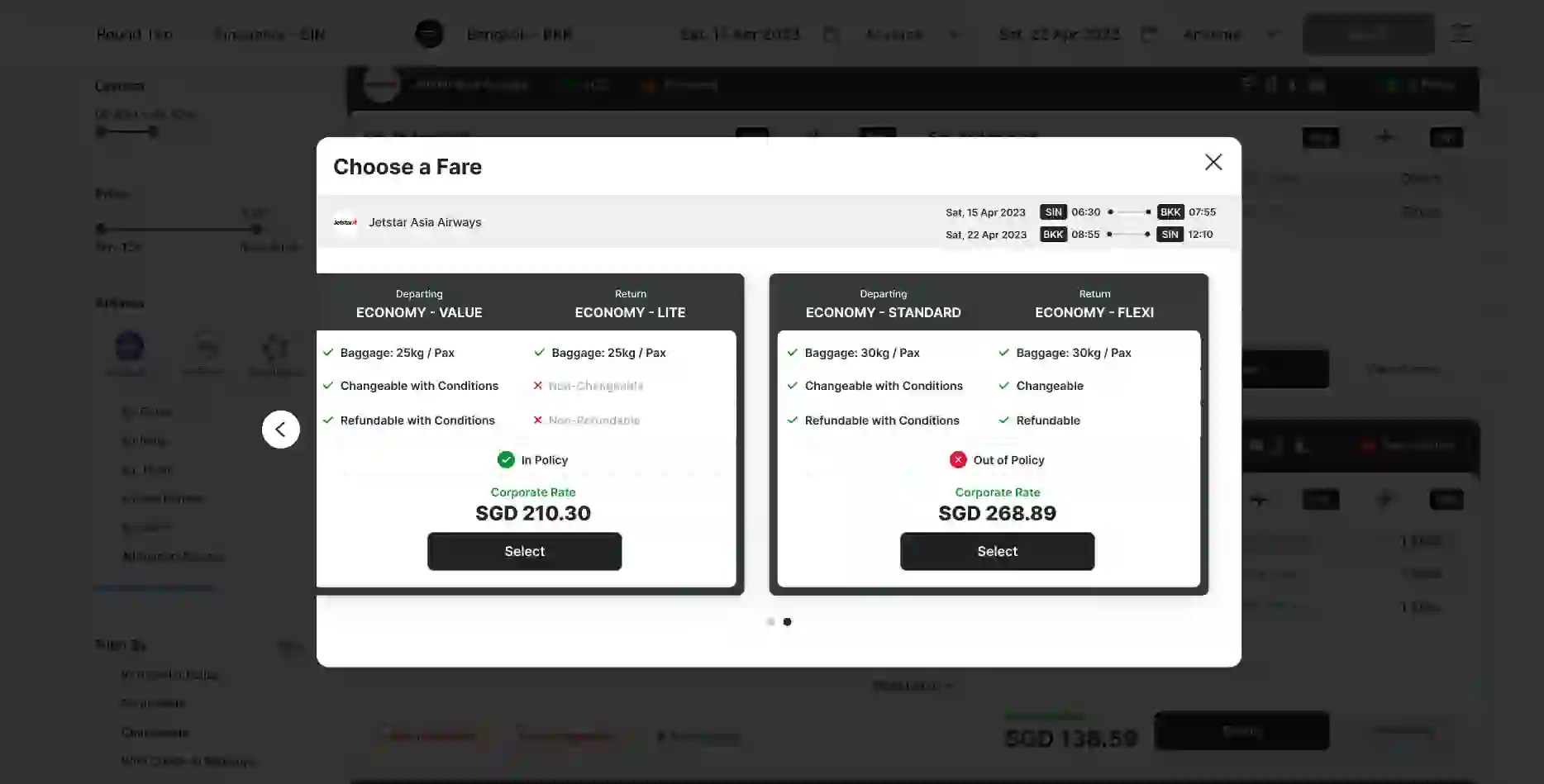
When an employee opens a corporate booking tool, they see only the results their policy allows. Flights above the approved fare class are hidden or flagged. Hotels above the rate cap are marked as out-of-policy before the employee clicks on them. Preferred suppliers are ranked first. The traveller does not need to know the policy — the tool has already applied it.
This approach eliminates the vast majority of unintentional non-compliance. Employees who book out-of-policy because they do not know the rules simply cannot make that mistake in a well-configured booking tool.
Approval Workflows Built Into the Booking Flow
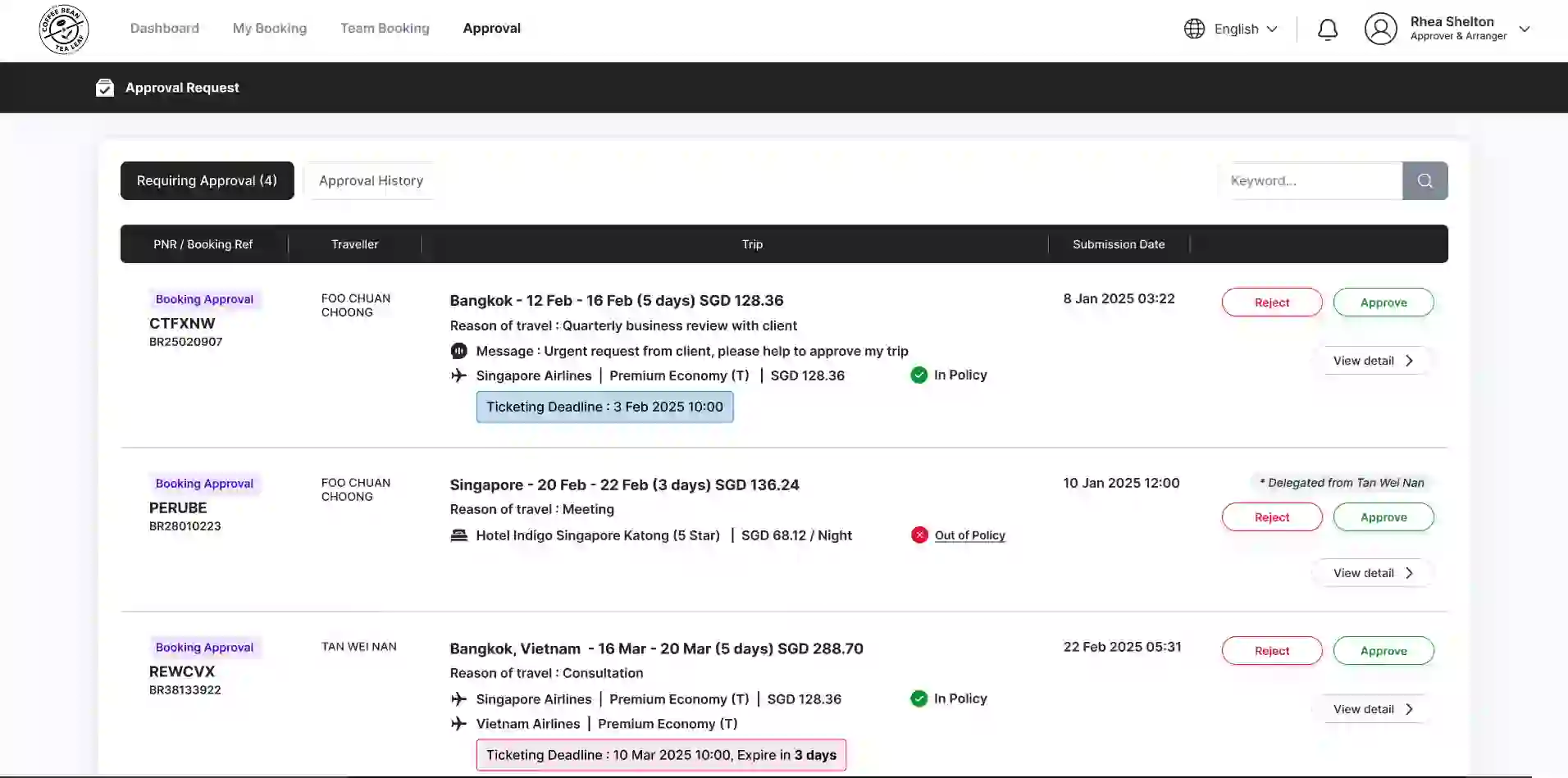
A modern corporate booking tool routes trip requests through configurable approval chains as part of the booking process, not as a separate step. Multi-level approvals — line manager, travel manager, finance — are triggered automatically based on the trip type, cost, or destination. In-policy bookings can be auto-approved. Out-of-policy selections require a justification code before the booking is submitted.
This means last-minute trips can still be handled efficiently through pre-approved corridors, while unusual requests are flagged for human review before money is spent.
Real-Time Visibility for Travel Managers
Every booking made through the tool generates clean, structured data: cost centre, policy flag status, approval history, supplier used, fare paid. Travel managers get a live dashboard rather than a monthly spreadsheet, and can intervene before problems compound. Finance teams receive booking data that feeds directly into expense and accounting systems, eliminating manual reconciliation.
For TMCs deploying this layer for their corporate clients, the mid-office connection is equally critical. SWIFT Mid-Back Office automatically validates each PNR against policy rules, calculates service fees, and generates clean billing data — so compliance checks run at the back-office level as a second layer of control, even for bookings that were initially made offline or through a consultant.
Handling Out-of-Policy Exceptions Without Breaking the Workflow
Good compliance infrastructure does not mean zero flexibility. A well-configured booking tool allows pre-approved exception corridors: a senior executive tier that can book business class on routes above a certain duration, an exception code for last-minute bookings within 48 hours, or a manager-approval bypass for in-country trips below a cost threshold. Flexibility built into the system is captured and auditable. Flexibility exercised outside the system is invisible.
Compliance Enforcement in Practice: Policy Checks at the GDS Level
For TMCs operating in a consultant-led booking environment, compliance enforcement can also happen at the GDS level. Forecepts’ work with Sabre Red Apps shows how policy rules can be embedded directly into the consultant’s GDS workflow: automatically pulling corporate policy data into the booking screen, validating PNR data at the end-transaction stage, intercepting non-compliant commands before tickets are issued, and verifying commission amounts at the ticketing stage.
This means compliance is not just a self-service OBT function. For TMCs handling complex itineraries through consultants, the same policy logic can run inside the GDS desktop — making it structurally impossible for a consultant to issue a non-compliant ticket without an explicit override
Travel Policy Compliance in APAC: Additional Considerations
For companies and TMCs operating across Asia-Pacific, travel policy compliance has several layers that do not apply in single-market programmes.
Multi-currency rate caps.
A hotel rate cap set in SGD behaves differently in Kuala Lumpur, Jakarta, or Ho Chi Minh City. Policies that do not account for local cost-of-living variations create either systematic over-spend in expensive markets or traveller hardship in affordable ones. Rate caps should be set per-city or per-tier, not as a single regional figure.
LCC and regional carrier complexity.
APAC itineraries frequently mix full-service carriers, regional LCCs, and budget airlines on the same trip. A booking tool that only pulls GDS content will miss LCC fares entirely, making the approved channel appear more expensive than direct booking — which directly drives non-compliance. Tools with direct LCC connectivity or aggregator integration are essential for APAC programme integrity.
Mobile-first booking behaviour.
With 69% of APAC business travellers using mobile wallets and high direct card access rates, travellers expect to complete the full booking on mobile. A policy compliance tool that does not work well on mobile will see employees defaulting to consumer apps where no policy enforcement exists.
Cross-border approval chains.
A traveller based in Singapore reporting to a manager in Hong Kong with a budget owner in Australia requires approval workflows that span time zones and entities. Approval chains that require a physical signature or same-timezone response create the conditions for bypass.
Final Thoughts
Travel policy compliance is not a communications problem. It is a process design problem. When booking within policy is as easy as booking outside it — or easier — compliance rates rise. When it requires more friction, more steps, or more memory than the alternative, they fall.
The companies and TMCs that achieve sustained high compliance are not the ones that send more reminder emails. They are the ones that have moved policy enforcement into the booking tool, where it operates automatically, consistently, and without depending on anyone to remember the rules.


