
 If you work in the travel industry, GDS is one of the first terms you encounter. It sits at the centre of how travel agents search and book flights, hotels, and other travel products. But what exactly is a GDS, how does it work, and which one should a travel agency in Asia connect to?
This guide answers all of those questions - and explains why GDS connectivity is a foundational part of the technology stack for any Travel Management Company or travel agency operating in Singapore, Malaysia, Hong Kong, and across Asia-Pacific.
1. What Is a GDS (Global Distribution System)?

A Global Distribution System (GDS) is a computer network that acts as a centralised marketplace connecting travel agents with suppliers - airlines, hotels, car rental companies, and other travel service providers. It aggregates inventory, schedules, and fares from hundreds of suppliers and makes them searchable and bookable through a single platform.
Before GDS systems existed, booking a flight required a travel agent to call the airline directly, wait for availability, and process the reservation manually. The GDS automated and centralised this process, giving agents instant access to live inventory from multiple airlines simultaneously.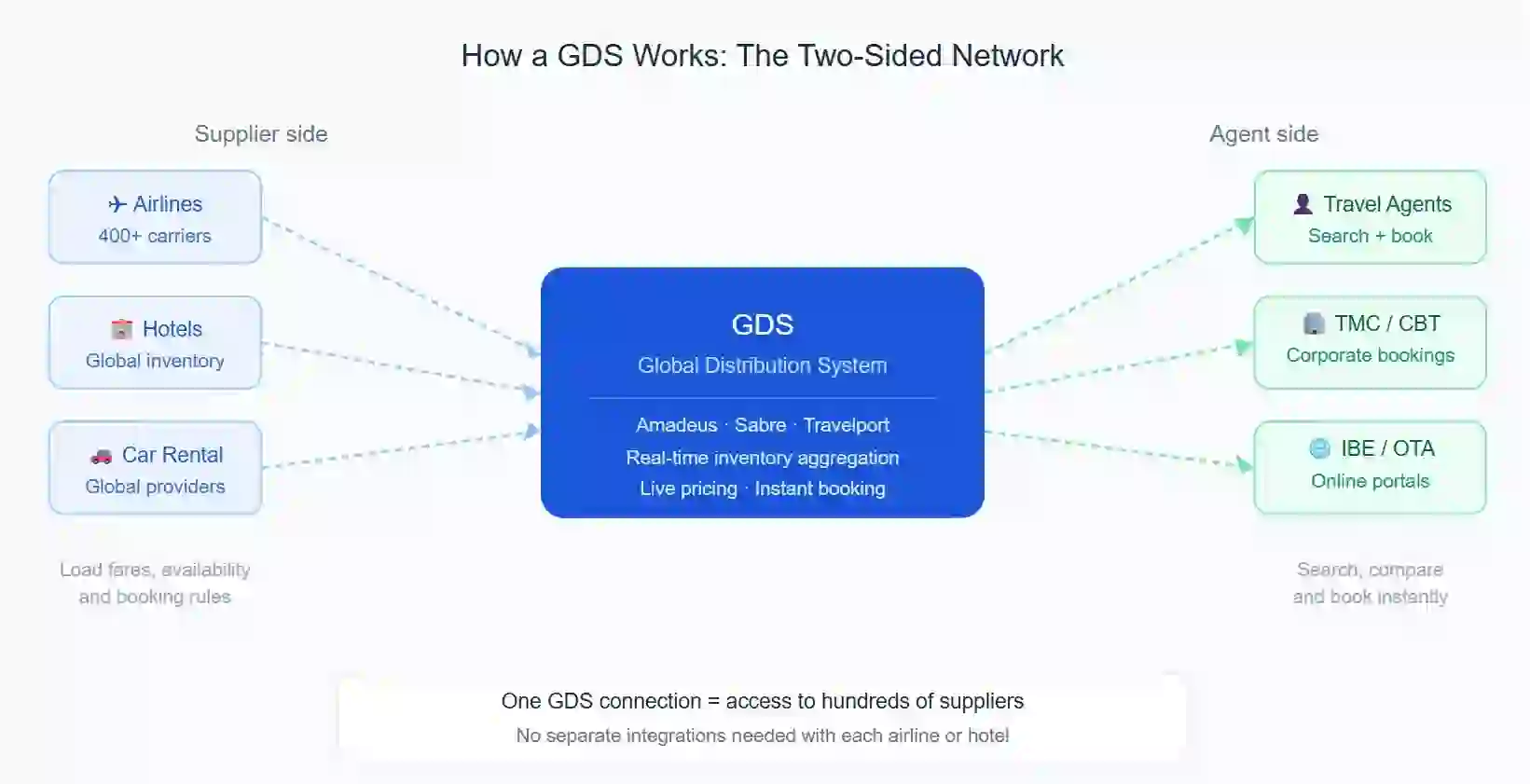
2.How Does a GDS Work?
A GDS operates as a two-sided network:
Supplier side
Airlines, hotels, and car rental companies connect their inventory systems to the GDS. They load their schedules, availability, fares, and booking rules into the GDS in real time. When a seat is sold through any channel - direct, OTA, or travel agent - the inventory updates across all connected systems instantly.
Agent side
Travel agents, TMCs, and internet booking engines connect to the GDS via an API or a terminal interface. When an agent searches for a flight, the query goes to the GDS, which returns available options from all connected airlines with real-time pricing. The agent selects an option and the GDS processes the booking directly with the airline's reservation system.
This two-sided model is what makes the GDS so powerful: a single connection to the GDS gives a travel agent access to hundreds of suppliers simultaneously, without needing separate integrations with each one.
3. The Major GDS and LCC/NDC Platforms Used in Asia
There are three dominant global GDS providers, plus one key LCC and NDC aggregator that is particularly relevant for the Asia market:
Amadeus
Headquartered in Madrid, Amadeus was founded in 1987 by four European airlines - Air France, Lufthansa, Iberia, and SAS. It is the largest GDS by market share globally, with a particularly strong presence in Europe, the Middle East, Africa, and Asia-Pacific. Amadeus connects over 400 airlines and is widely used by travel agencies across Singapore, Malaysia, and Hong Kong.
Sabre
Founded in 1960 as American Airlines' internal reservation system, Sabre is one of the oldest and most established GDS platforms. It has a strong presence in the Americas and Asia-Pacific, and is particularly well-adopted among corporate travel agencies and TMCs. Sabre's technology platform supports not just GDS connectivity but also a broader suite of travel technology products.
Travelport
Travelport is the parent company of three GDS platforms - Apollo, Galileo, and Worldspan - which were merged under the Travelport brand. It has strong coverage across North America, Europe, and parts of Asia. Travelport is also a leader in NDC adoption, having launched its own NDC-enabled platform for modern airline content distribution.
4.Beyond GDS: LCC and NDC Content Aggregators
Traditional GDS platforms provide comprehensive coverage of full-service airlines, but they have a significant gap: most Low-Cost Carriers (LCCs) do not distribute their content through GDS. For travel agencies in Asia - where LCCs account for a substantial share of regional traffic - this gap matters.
Travelfusion
Travelfusion is a leading LCC and NDC content aggregator that enables travel agencies, TMCs, and OTAs to access and book flights from over 450 airlines - including budget airlines that are not available on traditional GDS platforms. Founded in 2000, Travelfusion operates as a Direct Connect XML API provider, offering a direct booking link to airlines without routing through the traditional GDS infrastructure.
Travelfusion is particularly relevant for agencies in Asia where LCC travel is a major part of the market. Key capabilities include:
• LCC content access - book budget carriers like AirAsia, Scoot, and other LCCs that distribute outside of traditional GDS
• NDC content - access airlines' modern merchandising content including ancillaries, seat selection, and fare families
• Payment solutions - handles transactions directly with airlines via tfPay and tfMerchant
• Multi-modal content - includes rail and hotel content aggregation alongside flights
For travel agencies in Asia serving clients who frequently fly LCCs, connecting to Travelfusion alongside a traditional GDS gives comprehensive coverage across both full-service and budget carriers.
5. Amadeus vs Sabre vs Travelport: Which GDS Is Best for Travel Agents in Asia?
There is no single best option - the right combination depends on the markets you serve and the airlines your clients fly. Here is how the main platforms compare for travel agencies in Asia:
| Amadeus | Sabre | Travelport | Travelfusion | |
|---|---|---|---|---|
| Type | GDS | GDS | GDS | LCC/NDC aggregator |
| Full-service airlines | GDS | GDS | GDS | LCC/NDC aggregator |
| LCC content | Partial | Partial | Partial | Strong (450+ carriers) |
| NDC support | Yes | Yes | Yes (leader) | Yes (specialist) |
| Hotel content | Yes | Yes | Yes | No |
| Common in Asia | Yes | Yes | Less Common | Yes (for LCC) |
For travel agencies in Singapore, Malaysia, and Hong Kong, Amadeus and Sabre are the most common GDS platforms for full-service carrier content. Travelfusion is the key add-on for LCC access. Most agencies run both.
6. What Is the Role of GDS in the Travel Industry?
The GDS plays several critical roles in how the travel industry functions:
Centralised inventory access
Without a GDS, a travel agent would need to connect to each airline individually - a technically complex and commercially impractical task. The GDS aggregates hundreds of suppliers into a single access point, dramatically reducing the complexity of running a travel agency.
Real-time pricing and availability
GDS systems provide live, accurate pricing and seat availability. When an agent quotes a fare, that fare is confirmed against the airline's current inventory in real time. This prevents the over-booking and pricing errors that were common in manual booking processes.
Corporate fare distribution
Airlines negotiate special corporate fares with large corporate clients and TMCs. These fares are loaded into the GDS and are only visible to agents who have the correct credentials. This is one of the primary reasons companies use a Travel Management Company - access to corporate fares through the GDS that are not available on consumer booking platforms.
Global connectivity
A single GDS connection gives a travel agency in Singapore access to airlines, hotels, and car rental companies across every major market in the world. This global reach is what enables even a small travel agency to serve clients travelling internationally.
7. GDS vs NDC: What Is the Difference?
NDC (New Distribution Capability) is an IATA standard that allows airlines to distribute their content - fares, ancillaries, and personalised offers - directly to travel agents and booking tools without going through the traditional GDS.
This does not mean GDS is being replaced. Rather, the two systems are increasingly complementary:
| GDS | NDC | Best Approach | |
|---|---|---|---|
| Content breadth | 400+ airlines in one place | Airline-by-airline | GDS for broad search |
| Ancillaries | Limited | Full ancillary access | NDC for full offers |
| Corporate fares | Well establish | Growing | GDS still stronger |
| Personalisation | Limited | Strong | NDC for tailored offers |
| Technology | Mature | Newer, evolving | Depends on agency tech |
Modern travel agencies and TMCs in Asia are increasingly adopting a hybrid approach - using GDS as the foundation for broad inventory access, while adding NDC connections for airlines that offer exclusive content outside the GDS. The SWIFT Internet Booking Engine supports both GDS and NDC content, allowing agencies to access the best of both distribution channels from a single platform.
8. Do Travel Agents in Asia Still Need a GDS?
Yes - particularly for corporate travel. Here is why GDS remains essential for travel agencies and TMCs in Singapore, Malaysia, Hong Kong, and across Asia:
Corporate fare access
The vast majority of negotiated corporate fares are still distributed through the GDS. For TMCs serving corporate clients, GDS connectivity is not optional - it is the mechanism through which they access the rates that justify their value to clients.
Multi-airline itineraries
Complex itineraries that combine multiple airlines - particularly common in Asia where travellers might fly Singapore Airlines to a hub and connect on a regional carrier - are handled seamlessly through the GDS. The interline agreements and codeshare arrangements between airlines are built into the GDS infrastructure.
Depth of content and data
The GDS provides detailed information about every flight option - seat maps, fare rules, baggage allowances, aircraft type, connection times. This depth of data is essential for agents advising corporate clients on travel options, particularly for complex or high-value itineraries.
Established back-office integration
GDS bookings integrate directly with mid-back office systems for PNR management, invoicing, and BSP reconciliation. This established integration workflow is a significant operational advantage for agencies that process high volumes of bookings.
9. How Forecepts Connects Travel Agencies to GDS
Forecepts builds travel technology specifically for TMCs and travel agencies in Asia-Pacific. As a Sabre Gold Partner and authorised developer, Forecepts has direct expertise in GDS integration and develops solutions that leverage Sabre's full API capabilities - including GDS flight and hotel content, NDC, LCC, and aggregated hotel content.


